We are officially one month out from the start of the 2025 NFL Draft which means that you’re seeing mock drafts here, mock drafts there, mock drafts fucking everywhere!
Mock drafts and simulators can be an incredibly fun, helpful way to get to know some of the prospects in the class and as a way of understanding the lay of the land in terms of who is projected where or what insiders are hearing around the league.
However, they can also become a stumbling block that people can’t get over when the real thing happens. You spend weeks, even months, with an idea in your head about where certain players “should” be drafted and who will be available in later rounds, then your team makes a move that completely flies in the face of what you’ve had mapped out for the entirety of draft season.
As fun and informative as they can be, it’s important to remember that mock drafts are simply that – mocks. The various simulators that are available are often informed by one or two people’s player rankings, without taking into consideration specific scheme fits for a team or things outside the data like a player’s personality or previous relationships.
A player who might seem a “reach” on draft weekend might be the best fit for your team over three other players who’re ranked higher by analysts or a player you think might be available later in the process might actually be far more loved by the league than we’ll ever know. It only takes one team.
That mantra is particularly apt for the 2025 class with a huge number of players in each position group valued similarly so it’s more important than ever this year to not get too hung up on mock drafts and outside noise.
With all that said, shall we do a mock draft? We all love mock drafts.

The Arizona Cardinals additions in the initial stages of free agency, mainly the signings of Josh Sweat and Dalvin Tomlinson, has given them more freedom when it comes to the draft.
Rather than being desperately tied to adding either a pass-rusher or defensive tackle early on, they now have some wiggle room to play with. That makes judging what their strategy might be more difficult than in previous years under this regime.
If a trade offer comes Monti Ossenfort’s way for the #16 pick, someone of the calibre of Will Johnson falls their way or an offensive tackle they heavily favour is still available, the team have the ability to consider those options
To reflect this, instead of cherry picking the “best” draft I could muster up, I conducted a bit of an experiment. What you’ll see below is the combined result of 20 mock drafts, split evenly between the PFF and PFN simulators. To keep results fair, there we no trades made.
For each pick, I allowed myself the ability to select from the top 15 ranked players that were left, as long as there weren’t any egregious anomalies.
For example, PFN sometimes has both Kenneth Grant and Walter Nolen available at #47 for the Cardinals. That won’t happen unless something drastic occurs over the next month.
The most popular pick in each round made the cut and is profiled below and we’ll also go through some of the key takeaways from each round.
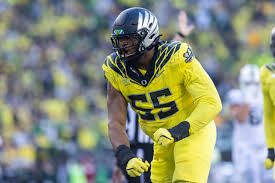
Round 1, Pick 16: Derrick Harmon – DT – Oregon – 6’4” ½ – 313lbs – 34” ⅜ arms – 21 years old
Projected to be more of a run stuffing tackle during his time at Michigan State, Harmon dropped a considerable amount of weight after transferring to Oregon in 2024 (reportedly 15 lbs) and his game improved significantly.
Last year, Harmon recorded career-highs in tackles (45, with 10.5 TFLs), sacks (5), pass breakups (4) and forced fumbles (2) and has seen his stock rise continuously throughout the draft process.
The 55 pressures he created in 2024, according to PFF, was the most by any FBS defensive tackle while his 86.3 pass-rushing grade from the platform tied for fourth overall. On true-pass sets, Harmon graded out at a whopping 91.2 with a 17.6% pass-rush win rate.
That output saw him win Second-Team All-American honours.
A tremendous block shedder, the 21-year-old possesses a push-pull move that is so sudden and expertly drilled that it can make opposing linemen look like they have simply decided not to block him on tape.
Knowing when and how to use his hands is a primary weapon for Harmon. He simply *gets* it, when it comes to being a defensive lineman.
He pairs that knowledge with quick feet to cut across the face of opposing linemen with club, rip or swim moves. We often talk about pass-rushing players having explosive first steps, but Harmon has an explosive second, third and fourth step too.
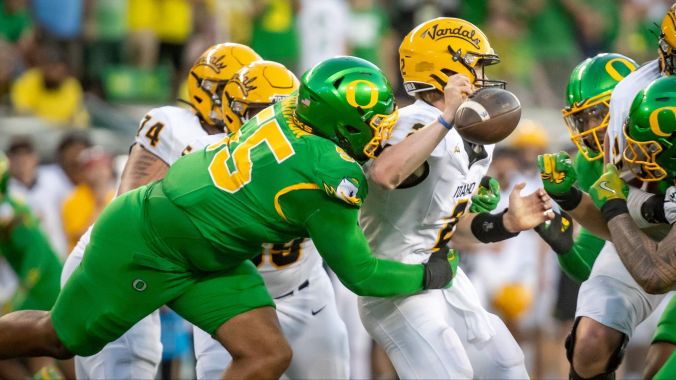
His speed was on display at the NFL Combine where he scored the joint 5th fastest 40 time (4.95 secs) and split (1.74 secs) amongst DTs.
A popular prospect amongst Cardinals fans, there are concerns around Harmon that have to be taken into account.
The first is that this incarnation of Derrick Harmon, production and all, has been a one year deal. Selecting him at #16 would be an investment in a work in progress player rather than a more sure fire thing (if such a thing exists), though the potential greatly outweighs that.
Secondly, while it has made him a far more exciting and productive player, losing that amount of weight is still something that Harmon is getting used to.
There are times where his balance is an issue and you get the impression that he’s not 100% comfortable in his new frame yet both at the line of scrimmage where he can be knocked off balance or in open play where he had a 27% missed tackle rate – 10th highest amongst his peers.
Maybe the most pressing concern for Cardinals fans who’ve set their sights on him, is that he *might* not be the best scheme fit compared to other similarly ranked tackles. Though he has the capability of excelling in a 3-4 system, Harmon’s best work looks like it’ll come as a 3-tech in a 4-3 front right now.
FIRST ROUND TAKEAWAYS: This was a hot competition between Harmon (4 picks), Kenneth Grant (3 picks) and James Pearce Jr. (3 picks) that ultimately came down to availability. Armand Membou and Kelvin Banks Jr. were the only offensive selections across the 20 mocks, with one pick apiece.
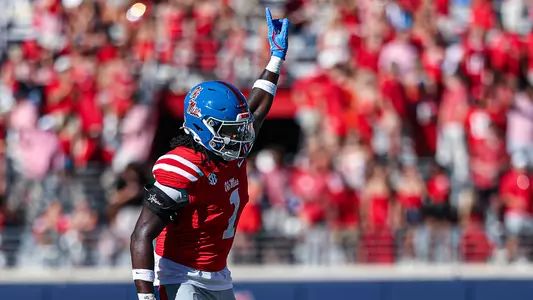
Round 2, Pick 47: Princely Umanmielen – EDGE/OLB – Ole Miss – 6’4” – 244lbs – 33” ⅞ arms – 22 years old
Princely Umanmielen is a human highlight reel.
When the Ole Miss rusher is at his best, he’s a joy to watch. Able to win with electric burst and length, Umanmielen has left a trail of embarrassed young men wishing they’d never put on a football helmet.
The Florida transfer posted a staggering 22.8% pass rush win rate, with a 91.4 PFF pass rush grade, using his first step and lateral quickness to ease past his opposing number. This resulted in 11 sacks and 58 pressures in 2024.
When he was able to isolate a linemen out in space, it was goodnight and God bless.
Despite being a player who wins via that quickness and finesse, Umanmielen isn’t a pushover. He weighed in at 264 lbs upon arrival at the Senior Bowl, has contributed in the run game while at Ole Miss and has even shown glimpses of being able to convert his speed to power. He then dropped to 244 lbs for the Combine, showing discipline and a competitive streak that not everyone has.
That weightcut, along with his natural burst and explosiveness, resulted in tying 6th amongst defensive ends on the split time for the 40 (1.62) and being fourth best at the position for the vertical (38) and broad jumps (10’6”).
Unfortunately for Princely, football isn’t (or at least it shouldn’t be) judged purely on highlight reel moments. When the 22-year-old doesn’t win with his explosiveness in the first instance, he can be halted and often flounders in the arms of a tackle, so he’s going to have to expand his pass-rush weaponry at the next level.
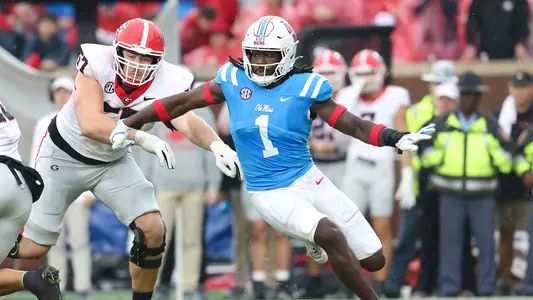
That need for consistency paired with his development as a run defender, primarily in becoming stronger and knowing how to best use that strength at the point of attack, is what knocks him down a tier or two when you rank the 2024 EDGE class.
If a coaching staff can help Princely Umanmielen pull all of those things together, they would have a very valuable weapon on their roster.
I would back Jonathan Gannon and Nick Rallis to make a good attempt at that, if the opportunity arose.
SECOND ROUND TAKEAWAYS: Like Round 1, this selection came down to a battle between three players – Umanmielen (4), Landon Jackson (3) and Aireontae Ersey (3) that was ultimately decided by availability.
In a straight shootout, I’d likely be more tempted by Jackson, as he brings a bit more variety than Princely who would offer the same kind of traits as BJ Ojulari and Baron Browning, or by Ersery as the last big-time tackle prospect.
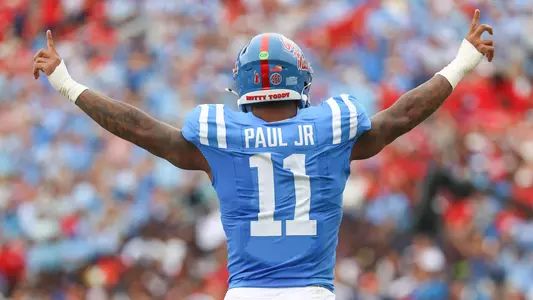
Round 3, Pick 78: Chris Paul Jr. – MLB – Ole Miss – 6’1” – 222lbs – 29” ⅞ arms – 22 years old
A second-team All-SEC and a first-team All-American (by USA Today) in 2024, Chris Paul Jr. brings the coverage skills that were lacking in the Cardinals linebacking room this year.
Paul’s 19 coverage stops was tied for 15th in the nation amongst linebackers, with his 4 forced incompletions tied for 26th, highlighting the instincts and recognition skills that are easily identifiable for anyone who watched Ole Miss’s defence over the past year.
It was an area that the linebacker wanted to address when he transferred to Ole Miss, with this year being by far his best in that area of the field.
Nicknamed “Pooh” by his family, the Arkansas graduate may also be the best tackler amongst the 2024 linebacker class.
Showing textbook execution when bringing down the ball carrier, Paul missed just 4 tackles on 621 defensive snaps all season which equated to the lowest missed tackle rate in the entire 2025 linebacker class – 4.5%. Over the course of the last two seasons, that equals to 6.2%.
The 22-year-old ranked seventh among all FBS linebackers with an 87.2 PFF grade, one of just three players be graded at 78 and above in run defence, coverage and rushing the passer.
Showing a renewed focus on physicality after discussions with his linebackers coach at Ole Miss, with scouts wanting to see more from him in that department, Paul Jr. displayed an intensity that had him shocking much bigger men.
In a brilliant interview from the Shrine Bowl with Bootleg Football, Paul explains his philosophy in simple terms – “I get a guard, I’m tryna blow it up”.
Having been a key part of bringing together a defence that boasted several first-year transfers which would go on to be the nation’s second stingiest – giving up 14.4 points per game – is a testament to Chris Paul’s character. He feels like a Ossenfort/Gannon type of dude.
The obvious concerns for Paul in making the step-up to the pro game is his frame. He needs to add mass quickly. He can get knocked around at the college level especially when he doesn’t have the downhill momentum to crash into other players, so it will be a case of taking his vitamins and saying his prayers as soon as he lands with his new team.
CPJ also does’t have the speed you’d associate with such a slight frame – 10 linebackers had a better 40 time than him at the Combine (4.63) and he had the 2nd worst split (1.62).
Though they added Akeem Davis-Gaither and Mykal Walker to their linebacker corps in free agency, Paul feels like a great fit both on and off the field for the Cardinals.
THIRD ROUND TAKEAWAYS: Paul edged out Omarr Norman-Lott and Jonah Savaiinaea with four picks to three here. Darius Alexander, Tate Ratledge and TJ Sanders also had two selections each. Round 3 had the least variety of players selected with 10.

Round 4, Pick 115: CJ West – DT – Indiana – 6’1” – 316 lbs – 31” ½ arms – Age Not Available At Time of Writing
As Indiana made an unlikely march to the College Football Playoffs, one of their most eye-catching prospects was a defensive tackle transfer from Kent State, by the name of CJ West.
Having ironed out some of the more alarming holes West had shown at Kent State, specifically improving his reaction time to the ball being snapped and being more consistent with his pad level, the redshirt senior made waves against both the rush and pass.
A PFF run defence grade of 88.1, a pass rush win rate of 10.1% and a run-stop rate of 11.4% led to West being the outlet’s #2 ranked interior defensive linemen in the Big 10.
Predominantly lined up in the A gap, with some B gap flexibility, West was able to take the step up in competition in his stride with some of his best work coming against his best opposition in Michigan, Notre Dame and Washington.
He brings a rabid mentality to the defensive front which could be a positive and a negative for his evaluation. Teams will love the heart and violence but it does go overboard at times leading to wild tackling attempts and overcommitting which can be countered by better players.
He shouldn’t give up the leverage battle as much as he does, given his size, though that’s a coachable issue.
West followed up his great season with the Hoosiers by impressing at the Shrine Bowl before putting in a terrific performance at the Combine; he had the joint 5th best 40 time (4.95), 5th best split (1.73) and 6th best vertical jump (33). That earned him a 9.15 RAS out of a possible 10, the 158th best out of 1845 DTs from 1987 to 2025.
His physical limitations in terms of arm length and height pose obstacles for him to overcome at the NFL level – his short arms don’t help his tackling technique – but a common comparison to Poona Ford who shared similar measurables gives an idea of what his ceiling could be.
West would give the Cardinals a rotational nose tackle option to develop behind Dalvin Tomlinson, with the added bonus of being able to pop up along the line.
FOURTH ROUND TAKEAWAYS: This was the supplemental defensive tackle round with West, Aeneas Peebles, Jamaree Caldwell and JJ Pegues sharing 11 of the selections. It also represented the first time this experiment had a strategy issue – if the Cardinals go with a DT early they likely won’t add another. Cam Skattebo received 2 picks (the two times he was available).
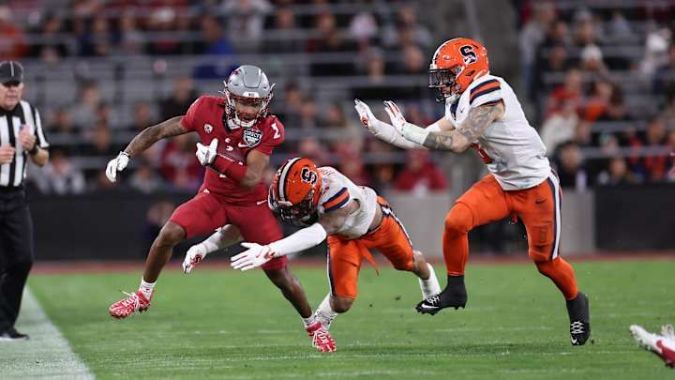
Round 5, Pick 152: Kyle Williams – WR – 5’11” – 190 lbs – 30” ⅛ arms – 22 years old
Since Christian Kirk left for Jacksonville, it has felt like Cardinals fans have been hoping for a field-stretching wide receiver option to be added to the offence.
At this stage of the draft, nobody fills that job description better than Washington State’s Kyle Williams.
If you go purely on Combine numbers, Williams doesn’t scream deep threat playmaker – his 4.40 40 time was tied 11th amongst receivers and only 5 players had a slower split (1.55) – but football isn’t played out in a vest and shorts. In actual game scenarios Williams is much quicker than that. He was the fastest receiver at Senior Bowl practices, clocking in a top speed of 21.36 mph.
The 14 receiving touchdowns Williams scored in 2024 ranked fourth in college football, with the 8th most overall yards in the nation with 1198 yards, as he led the Cougars with 70 receptions.
Demonstrating strength and bravery through contact, both in open play and at the catchpoint, Williams averaged 8.4 yards after contact in 2024 tied for 15th amongst receivers. He showed great playmaking ability after receptions as he reaches top speed.
While he compiled the 11th most screen yards (232), the majority of his work came down the field as he made 14 deep catches (tied for 10th amongst receivers) for 454 deep yards (tied 24th) i.e. any pass that travelled through the air for 20+ yards. Williams averaged 17.1 yards per catch and 2.71 yards per route run.
Lining up both outside and in the slot, the former UNLV prospect shows good body control particularly when close to the touchline.
Though he could be an exciting addition to any NFL roster, Williams has several glaring holes in his game that need to be improved upon for him to be a significant contributor.
In 2024, he dropped 5 catchable passes (a 6.7% rate) and much of this is down to being a body catcher rather than having the confidence in his hands.
There will also be some concerns over his route running ability. His most eyecatching work was done when Washington deployed a “fuck it, Kyle will be down there somewhere” attitude and had him beat the corner with straight speed but that’s kind of what you’d be drafting him for, at least initially.
With Greg Dortch still to sign his tender, there may be an opening in the slot for somebody to fill this offseason. While the Cardinals have added a number of receivers late on in previous drafts and have some veterans currently on the roster, I don’t think that will stop them adding to the room if the situation arises.
FIFTH ROUND TAKEAWAYS: This was the messiest round so far with eight different positions getting at least 1 pick out of the 20 mocks. It was also the first time I had some serious doubt about the main choices that were made – Williams just pipped linebackers Jack Kiser and Kobe King.
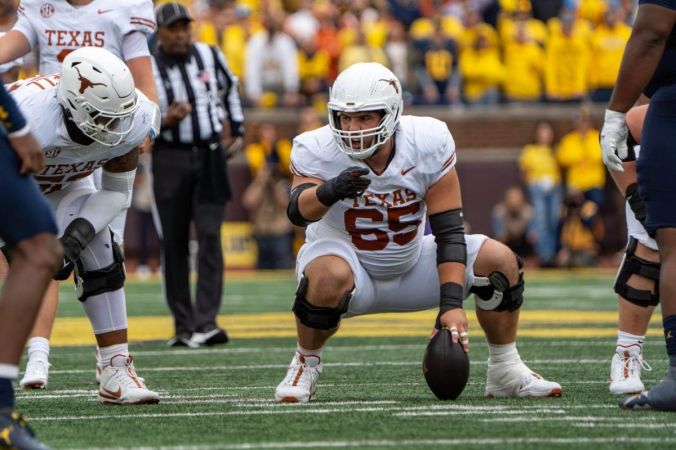
Round 7, Pick 225: Jake Majors – C – Texas – 6’3” – 306 lbs – 30” ⅜ arms – 23 years old
Jake Majors may be a short-armed, center only prospect but he is an incredibly well experienced one.
Amassing over 2800 snaps in the last three seasons, the 2024 Campbell Trophy finalist broke the Texas Longhorns record for consecutive starts with 56 starts in 57 games.
A coach’s favourite while at Texas, Majors is a sharp processor with elite football IQ, capable of diagnosing opposing fronts in an instant.
An AFC National Scout told Lance Zierlein that “that (Texas) building is crazy about him because of his leadership and just how sharp he is. He can make protection adjustments on the fly like an NFL veteran”.
Achieving All-State and All-American honours while at Texas, the 23-year-old plays smartly when combating longer, bigger and stronger defensive opponents, with the kind of hand placement you’d expect from a multi-year starter on a Texas line.
Earning a 85.4 PFF pass block grade for last season, the Texan native keeps a wide stance that can mitigate for his lack of game-defining power.
Majors isn’t the strongest or the quickest, but he has enough in the tank to keep defenders away from the ball carrier time and again, only giving up 1 sack since 2022.
His high-level football acumen gives him an opportunity to become a stable, reliable NFL back-up who won’t worry coaches if he has to deputise because of his understanding of the game.
SEVENTH ROUND TAKEAWAYS: It’s the seventh round, guys. There were 15 different players across 10 positions involved in this round. Do the Cardinals need a backup center? Maybe not. There’s slim pickings after the first 224 players are off the board.
Image Credits: Oregon Live, Ole Miss Athletics, Indiana University Athletics, The Daily Texan
 Erimus Sports